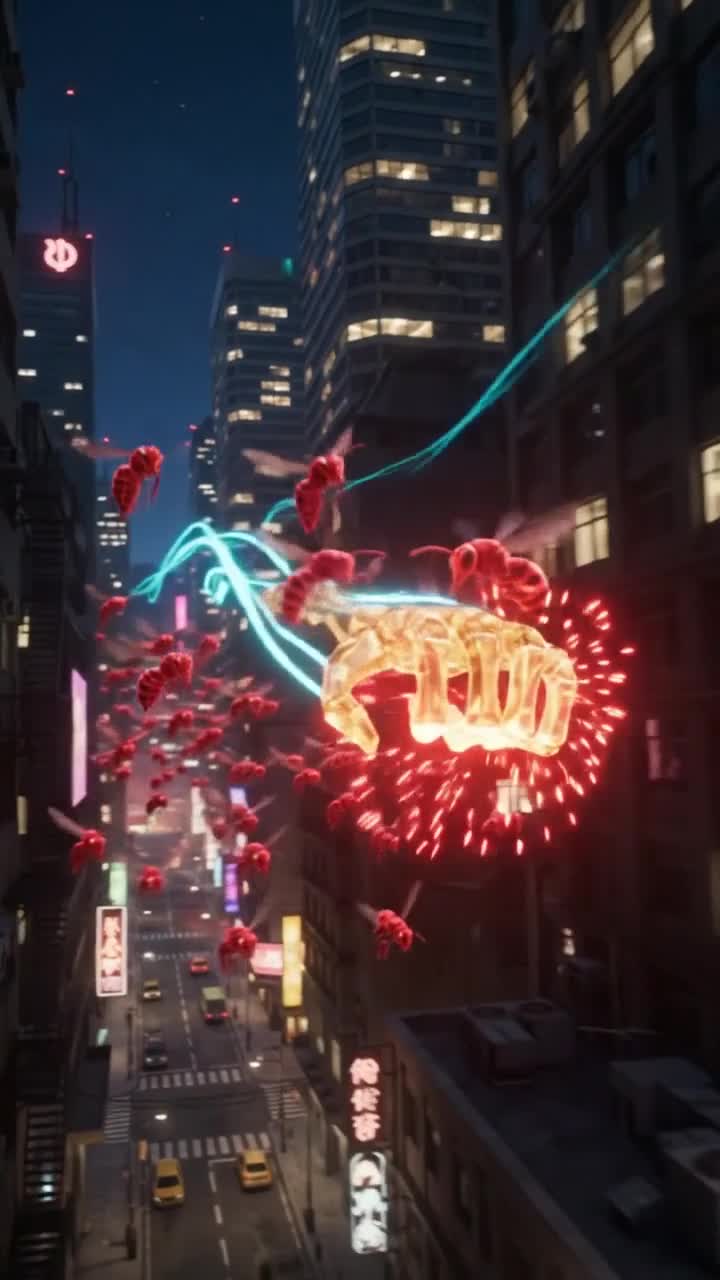
RheumaView™ Insights · Visual essay · 35-second film
What happens when a radiograph refuses to stay inside its frame?
A hand X-ray has a modest job: stay still, show what lies beneath the skin, and avoid making a scene.
In this film, it fails spectacularly. A golden skeleton bursts from the image and takes off above a neon city. Strange red creatures swarm around it. Blue light flashes. The hand flies, dodges, and throws a punch, apparently unaware that radiographs are not supposed to have an adventurous side.
Real X-rays are quieter. They can reveal alignment, joint spaces, fractures, and some forms of bone damage. Their power comes from holding a moment still. But a hand is never only its bones. The image cannot tell us whether that hand opened a stubborn jar this morning, struggled with a shirt button, or reached for someone else’s.
At the end, we return to the clinical room. A doctor smiles at the radiograph. Perhaps she knows something the picture does not: we study still images to understand people who are anything but still.
The X-ray captures a hand. It does not capture its life.
Film and essay by Olga Goodman, MD · RheumaView™. The animation is imaginative fiction; its flying hand and red creatures do not represent an anatomical or biological process.
Related reading: The Mirror Leaves a Lot Out · Imaging intelligence should be able to show its work.