Clinical reasoning · Interactive education
Convergence: Why a Case You Run?
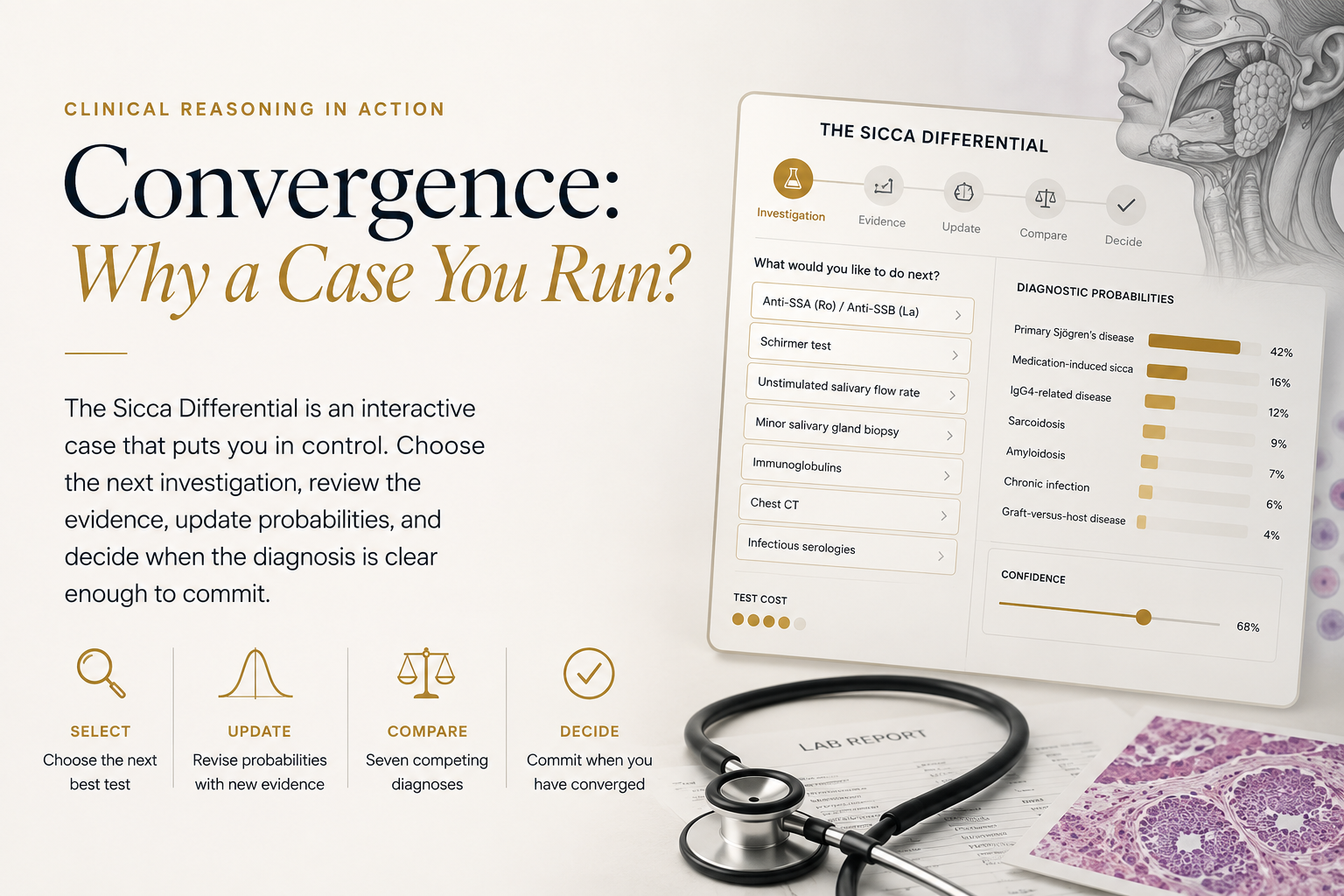
The Sicca Differential is not a conventional quiz. It is a compact simulation of how clinicians select evidence, revise diagnostic probability, and decide when enough information is truly enough.
A Case of Sicca: Sjögren’s and Its Mimics — A Case You Run
Dry eyes and dry mouth are common complaints, but they do not identify a diagnosis. Sicca may occur in Sjögren’s disease, yet the same symptom pattern can also result from medications, chronic infection, prior head-and-neck radiation, sarcoidosis, amyloidosis, graft-versus-host disease, IgG4-related disease, and other systemic or non-autoimmune conditions. The difficult part is not recognizing dryness. It is determining what is causing it.
The Sicca Differential is an interactive clinical case built around that uncertainty. Instead of presenting a completed vignette followed by a list of answers, it gives the learner a patient whose diagnosis remains open. The learner chooses which investigation to obtain next, reviews the result, and updates the likelihood of seven competing explanations. The case can be concluded whenever the available evidence feels sufficient.
Why the learner controls the workup
This design matters because clinical reasoning is sequential. Physicians rarely receive every relevant result at the same time. They must decide whether the next useful step is serology, an ocular test, salivary-flow measurement, imaging, biopsy, infection testing, or a closer examination of exposures and prior treatment.
Each choice may change the diagnostic landscape, but each investigation also carries a cost within the simulation. Ordering more tests is therefore not automatically better. The central task is to identify which piece of information is most likely to separate the leading possibilities.
The exercise evaluates more than the final diagnosis. It also examines how appropriately confidence changes as evidence accumulates and whether the conclusion is reached efficiently. Arriving at the correct answer after exhausting the full test menu is different from selecting a small number of discriminating investigations and stopping when the remaining uncertainty is acceptably low.
The challenge is not simply to know which tests exist. It is to know which test matters next—and whether another test would actually change the decision.
Why Sjögren’s is an ideal model
Sjögren’s disease is especially well suited to this format because it demonstrates the difference between symptoms, objective findings, classification criteria, and clinical diagnosis. Dryness establishes a problem, not its cause. An abnormal Schirmer test or reduced salivary flow confirms gland dysfunction, but does not explain why that dysfunction is present.
Positive anti-SSA/Ro antibodies or a supportive minor salivary-gland biopsy may substantially increase the probability of Sjögren’s, but the meaning of those findings still depends on the rest of the case. The competing diagnoses in the simulation reflect the practical logic behind the exclusion framework. Each represents a condition capable of producing a similar clinical picture or changing the interpretation of otherwise persuasive evidence.
The learner must therefore ask not only, “Does this result support Sjögren’s?” but also, “Could another disease produce this finding, and what evidence would distinguish it?”
From accumulation to convergence
This is why the exercise is described as a convergence case. With every selected investigation, some explanations become more plausible and others less so. The diagnostic field gradually narrows until one conclusion is sufficiently supported—or until an early assumption must be reconsidered.
The educational target is calibration. Good clinical reasoning requires more than naming the most likely diagnosis. It requires knowing how strongly the evidence supports that conclusion, which important alternative remains, and whether another test is likely to alter the decision. Overconfidence after a nonspecific result and underconfidence after a highly discriminating result are both reasoning errors.
The format also makes testing habits visible. Some learners search too broadly. Some anchor early. Others continue ordering low-yield studies because requesting another test feels safer than committing. By exposing the sequence of decisions, the simulation turns those habits into something that can be examined and improved.
The Sicca Differential is not a memory quiz and not a simplified diagnostic calculator. It is a compact simulation of evidence selection, probability revision, exclusion logic, and stopping judgment. The goal is not to order more. It is to recognize which information matters, use it at the right time, revise confidence honestly, and know when the case has truly converged.