The Cartographer’s Read
In which a radiologist mistakes a treasure map for a poorly collimated study, and a baobab for a patient.

Mercer had read films for thirty years, and it had ruined him for ordinary life. He could not look at a sunset without wanting a lateral view. So when somebody slapped a treasure map on the breakfast table, the whole crew saw gold and Mercer saw a bad study — underpenetrated, badly positioned, and frankly over-read by whatever Portuguese clown drew it in 1540.

Kwame, the guide, set his coffee down and said the X was right there. That, said Mercer, was the trap. Look at the ghosting along the bottom edge — the cartographer’s hand moved during acquisition. The X was artifact. The real marker was two centimeters to the side, where nobody would think to look. He’d watched scaphoid fractures pull that exact stunt for decades: hide in plain sight, then turn up six weeks later in a deposition.

By noon he had reread the entire map and soured everyone on the whole expedition. The palm grove? Coarse trabeculae, drought remodeling, he’d want priors. A line of hills? Bowel gas. Can’t read through it, and neither could he. Ignore it.

Then he hit the big baobab on the riverbank and went still in a way that made Kwame nervous.
“It is a tree,” Kwame said. “It is a tree with positive findings,” Mercer answered, “and I’d stake my fellowship on it.” You don’t dig under a tree because it has arthritis, Kwame tried. Ankylosis, Mercer corrected — arthritis was the surgeons’ department; they treat it, they don’t understand it.

They dug where he wanted — a couple of feet medial to the obvious X, under the spondylitic baobab. Four feet down, the shovel rang on iron.

Kwame tore the lid open: doubloons heaped to the brim, two emeralds, a little ivory crucifix on top. He made a noise that does not transcribe. Say something, he gasped. We’re rich. Mercer leaned over the hoard and frowned the frown of a man who has never once in his career committed to a diagnosis.
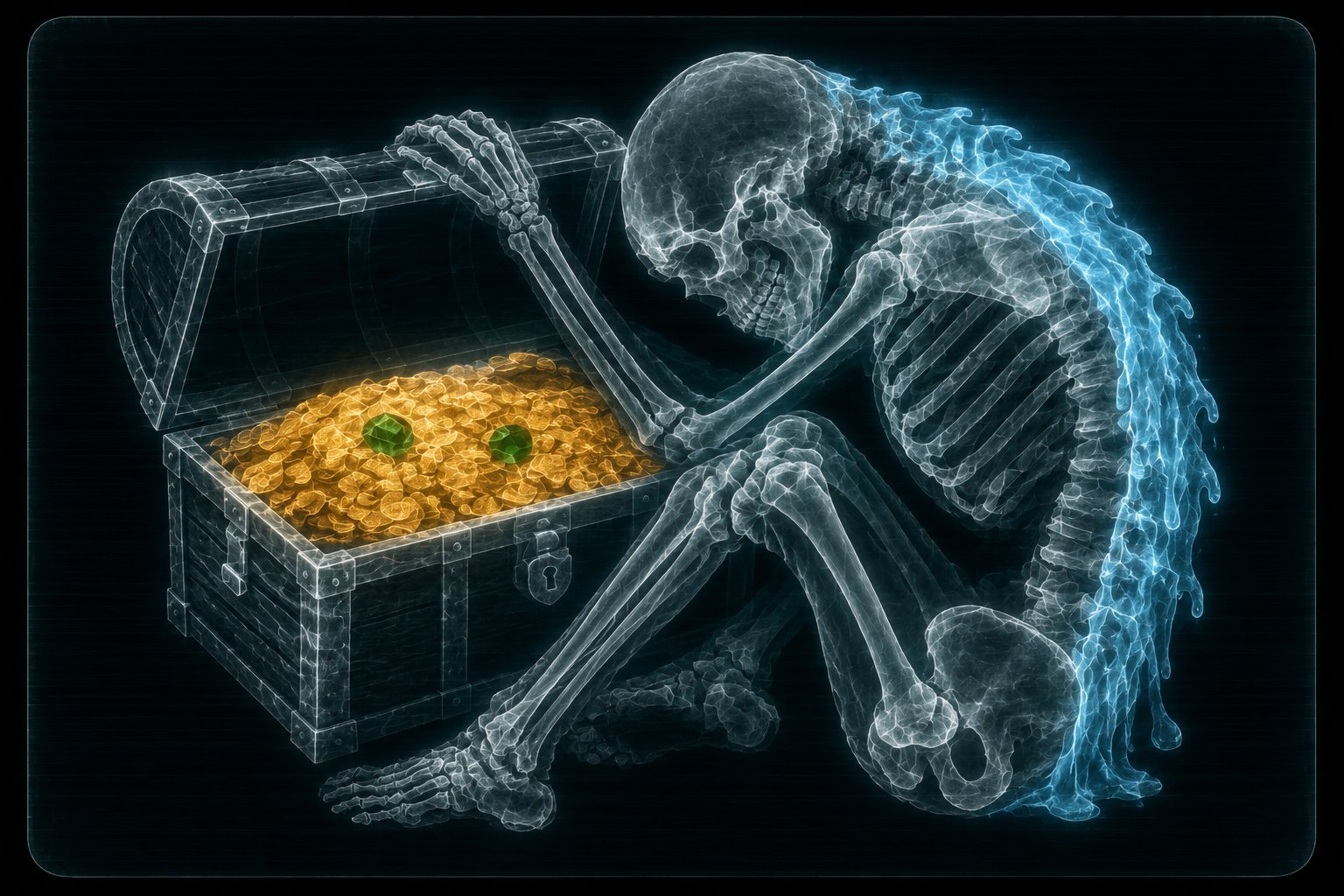
Then he stopped. He was not looking at the gold. He was looking at what was curled around the chest.

So the man had the gold. All of it. Climbed down, pulled the lid shut, and his own back did the rest — fused one ligament at a time, slow as anything, until one day he went to stand and couldn’t. Couldn’t bend, couldn’t climb, couldn’t reach the lid he’d closed on himself thirty years before.
The DISH didn’t kill him. It just made certain that once he was down there, he stayed.

“Findings nonspecific. Gold of indeterminate significance — cannot characterize without contrast. Patient declined further intervention. Recommend correlation with assay, and under no circumstances let the surgeon near it.”
Mercer told Kwame to fill the hole back in. Kwame buried the chest. Then he quietly kept three doubloons — one of which, against all radiological opinion, turned out to be extremely real.