RheumaView Insights
If Humans Had Tails: What It Would Actually Do to Your Spine
You had a tail once. Not metaphorically — early in development, the human embryo briefly carries a real caudal extension, built from the same developmental machinery that makes the rest of the spine. Then the body changes its mind. Over the next couple of weeks, much of that structure regresses through programmed cell death, and what remains becomes the coccyx — three to five small vertebrae at the base of the sacrum that mostly serve as an attachment point, sit quietly most of the time, and announce themselves only when you land on a hard floor.
So this isn’t a fairytale question. The plan existed. Development shut it down. What follows is an attempt to take it seriously: if we’d kept the tail, what would have had to change about the spine to make it work — and would we have come out ahead?
What a tail really is
It helps to be clear that a tail isn’t an accessory bolted onto the back. It’s the spine continuing past the pelvis — caudal vertebrae built by the same developmental machinery as the rest of the column, just getting smaller and simpler as they go. In a cat or a monkey, those vertebrae gradually shed their processes and arches until the far end is basically a string of bony beads riding on muscle and tendon.
Which is why we couldn’t just stretch the coccyx back out and start wagging. A working tail would mean halting the deletion program, re-extending the caudal series to maybe fifteen or twenty-five segments, rebuilding the flexor and extensor muscles we threw away, and running a fresh supply of nerves and blood vessels the whole length of it. Easy to picture, ruinously expensive to grow. Worth remembering next time you wish you had one for reaching the remote.
The part I’m not joking about: load
Here’s the fact everything else hangs off. The human spine is built for standing on two legs, and every feature of it is a solution to one problem — balancing a heavy head and trunk over two feet without falling over.
That’s what the curves are for. Neck forward, upper back back, lower back forward, then the sacrum — four alternating bends that work as a spring. A straight rod would transmit every jolt straight into the skull; the curves let the column flex and soak up compression, and they keep your weight stacked over the pelvis so you’re not constantly pitching forward.
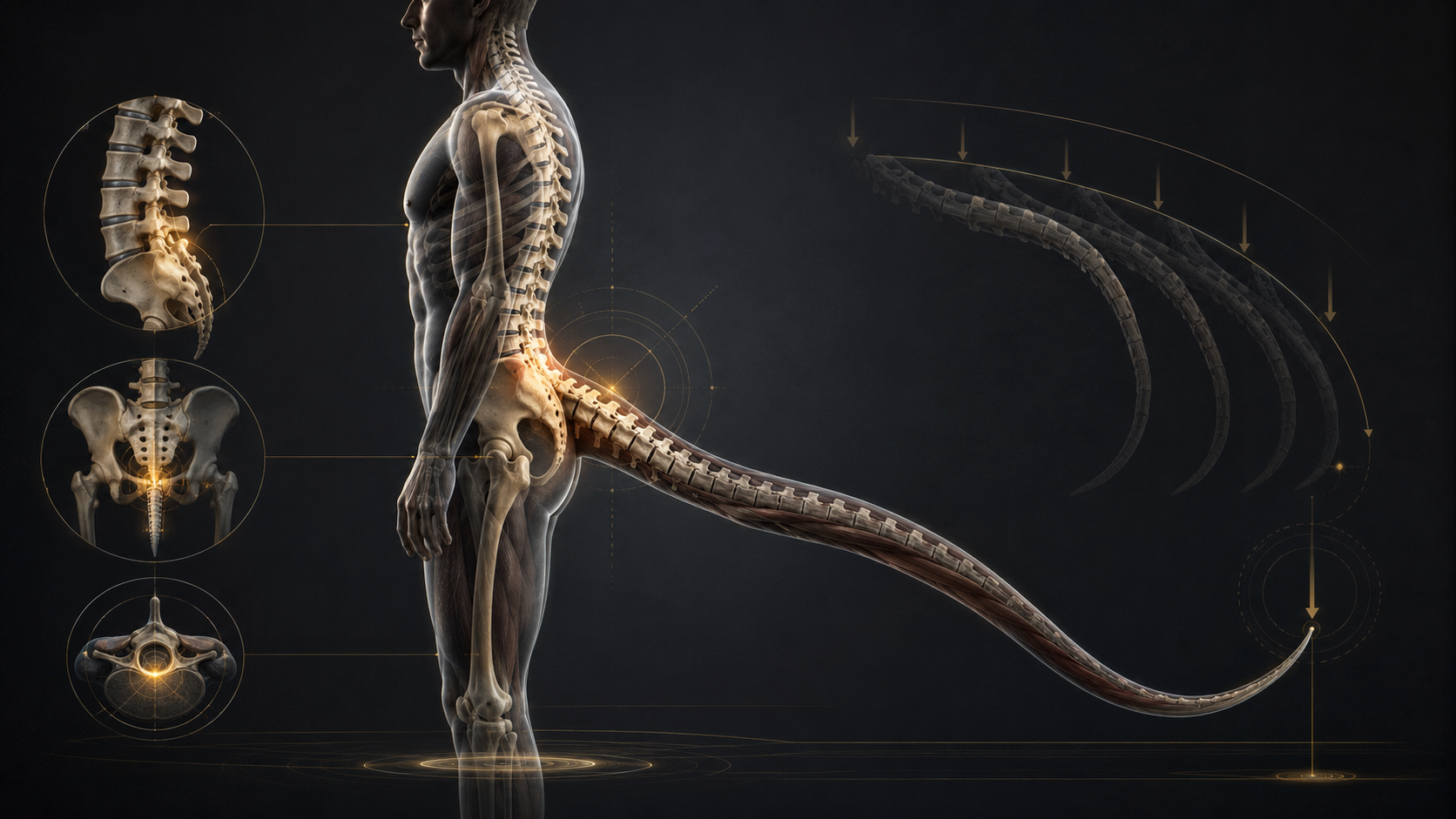
Now hang a tail off the back of that. Any real weight, even a moderate one, is a cantilever — mass sticking out behind the body’s center of gravity. Cantilevers make torque, and torque has to be fought somewhere. A cat gets away with it because its spine is horizontal, supported at both ends by limbs, with the tail’s weight spread along a forgiving load path. Stand the animal upright and the tail now dangles off the bottom of a vertical column, right at the spot where humans already break down most.
So the first prediction is grim and hard to argue with: a tail of any consequence would pile shear force and leverage onto the lumbosacral junction — L5–S1, where the mobile lumbar spine meets the fixed sacrum, often on a forward-tilted platform rather than a flat one. That junction is already one of the spine’s major stress points and a common site for degenerative change and slip. Add a posterior counterweight and you’ve designed a species that ships with a bad lower back as standard equipment.
What the rest of the skeleton would have to do about it
Evolution wouldn’t add the tail and walk away. To keep the animal upright it would have to rework the whole lower structure, and a few changes follow almost automatically from the mechanics.
The sacrum would get heavier. Ours is a wedge of five fused vertebrae passing load into the pelvis; to anchor a muscular tail it would need bigger articular surfaces at the bottom and much stronger muscle attachments — broad bony crests, closer to what tailed primates carry.
The pelvic floor is where it gets genuinely awkward. The muscles that once wagged the tail didn’t vanish — in us, levator ani and coccygeus got repurposed into a hammock that holds the abdominal organs in against gravity, a job that is far more demanding in an upright animal than in a quadruped, where abdominal organs are supported along a horizontal body wall. Bring the tail back and those same muscles can’t do both jobs well. You’d end up with a pelvic floor that’s a worse compromise for wagging and for continence. Pick your disappointment.
The curves would deepen, too. To drag the center of gravity back over the feet against all that new weight behind, the lumbar lordosis would likely increase and the pelvis tilt to match. More lordosis means more load on the facet joints and on the pars interarticularis — so, again, more stress fractures, more facet arthritis. The spine spends its whole life refereeing this, and the referee eventually files a workers’ comp claim.
And twenty extra vertebrae is twenty extra joints to wear out, plus a long lever sticking into the world that catches a doorframe every time you back up. New parts, new ways to break.
The case for the tail (it’s better than you’d think)
It isn’t all bad news and rueful X-rays. It would be silly to pretend tails are useless.
Balance, first, and this one is no joke. A tail is a fast inertial steering device. Cats, squirrels, monkeys — they fling the tail one way and the body rotates the other (conservation of angular momentum, same physics as a diver), correcting in mid-air and mid-stride. Robotics people have shown it over and over: stick a tail on a running or jumping robot and it recovers from stumbles and sticks landings much better. A tailed human would be a better gymnast, quicker through tight turns, and — here’s the serious version — much less likely to fall. Falls kill and disable enormous numbers of older people. A built-in counterbalance might be one of the more genuinely useful things we discarded.
Then there’s support. Kangaroos use the tail as a fifth limb, propping into a tripod at rest and even pushing off with it at slow speeds. A human tail strong enough to bear some weight could take load off the spine while standing — leaning back into your own tail like a built-in shooting stick. Whether that helps or hurts the lumbar spine on balance depends on how heavy the tail is and how you hold it, which is the kind of “it depends” that keeps biomechanists in business.
Tails also dump heat — they’re full of blood vessels and plenty of animals use them to cool off or warm up. And socially they’re loud. A dog’s tail can’t lie. Human poker would be much harder, and first dates a great deal more honest.
So who comes out ahead?
Add it up, and the verdict is pretty clear. The tail hands you balance, agility, fewer falls, a spare prop, and a face you can’t keep straight. In exchange it charges you a rebuilt and more fragile lumbosacral junction, a pelvic floor stuck doing two jobs badly, deeper spinal curves with the facet and pars wear that comes with them, and a whole extra column of joints to grind down across a lifetime.
Put plainly: a tail is a great organ for an animal that runs and leaps and climbs, and a lousy retrofit for one that stands upright for sixty years and then complains about its back. Somewhere down the line, natural selection ran that math and quietly closed the ticket. We kept the spring in the spine, the load-bearing wedge of sacrum, the borrowed pelvic floor — and let the tail dissolve before any of us drew breath.
There’s something almost elegant in that. The coccyx you’re sitting on isn’t junk left over by accident; it’s a decision, made in bone, to stop building the tail. So when it aches on a hard chair, take it as a bill — a few hundred thousand generations late — for the tail you never got to keep.
We’d have loved the thing. Our spines, frankly, dodged a bullet.
